
Zombie Animations for Games: Realistic Mocap & Game-Ready 3D Motion | AnimationShopee
Zombie animations give horror characters believable weight, imbalance, aggression, and unsettling body mechanics that instantly sell an undead performance.
Motion capture preserves the irregular timing, dragging steps, broken posture, sudden attacks, and recovery motion that make zombie movement feel physical instead of procedural.
Game-ready zombie animation assets help developers build enemies, cinematics, survival encounters, infected crowds, and horror gameplay faster without sacrificing movement quality.
For modern 3D pipelines, reusable mocap animation reduces repetitive keyframing and gives teams a realistic base that can still be retargeted, blended, edited, and stylized.
Explore production-ready character motion at AnimationShopee.

Why Zombie Animations Need More Than a Simple Walk Cycle
A convincing zombie rarely moves with the clean rhythm of a healthy character. The performance depends on asymmetry: one shoulder may drop, one leg may drag, the torso may lag behind the pelvis, and balance can shift unpredictably from step to step. That is why zombie animations benefit from motion that captures the entire body rather than isolated limb movement.
In horror games and cinematics, these imperfections create personality. A slow infected character can feel heavy and decayed, while an aggressive zombie can accelerate suddenly, lunge forward, stumble, recover, and attack with chaotic momentum. The movement style helps communicate threat before the character even reaches the player.
Game-Ready Zombie Animations for Horror and Survival Projects
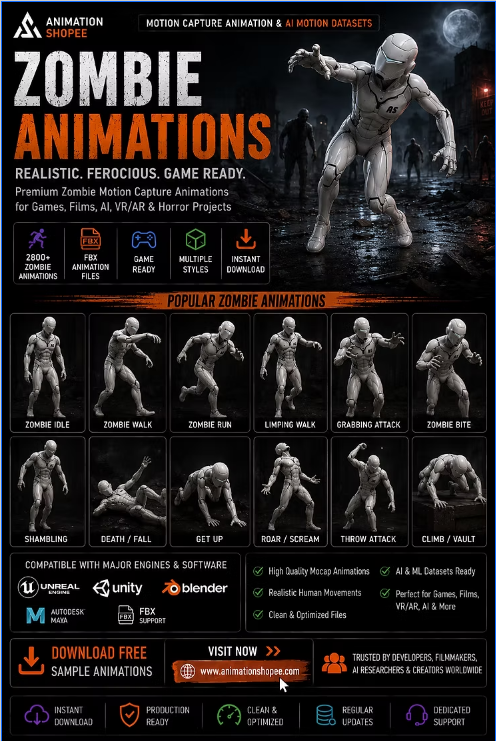
A useful zombie animation library can support far more than walking. Developers commonly need idle variations, slow locomotion, fast chases, turns, lunges, attacks, hit reactions, knockdowns, stand-ups, crawling, reaching, feeding behavior, transitions, and death motion. Starting with game-ready animation makes it easier to assemble these behaviors into responsive enemy systems.
Because the motion already contains realistic body coordination, gameplay teams can focus on state transitions, timing windows, collision, AI behavior, and encounter design. Animators can then refine the clips where needed instead of spending the entire production schedule building every base action from zero.
Motion Capture Adds Natural Weight to Undead Movement
Professional motion capture animation records the small physical reactions that make movement feel grounded: how the pelvis shifts when a foot lands, how the torso counterbalances a turn, how the arms follow a sudden change of direction, and how momentum continues after a lunge or stumble.
Those relationships are especially useful for zombie motion because the character may be intentionally unstable. The performer can explore uneven steps, collapsed posture, delayed reactions, spasms, dragging limbs, and sudden bursts of speed while the capture preserves the underlying physical continuity of the performance.
Zombie Motion for Humanoid Robots and Advanced Character Systems
For games, simulations, digital humans, and Humanoid Robots, zombie-style motion can also provide controlled reference for abnormal gait, balance recovery, asymmetric locomotion, and exaggerated full-body coordination.
Retargeting Zombie Animation Across Different Characters
Retargeting makes one motion source useful across multiple compatible character rigs. A captured zombie performance can be adapted to different body proportions, enemy types, costumes, and creature designs while preserving the main timing and intent of the original performance.
After retargeting, artists can push the motion further by changing playback speed, layering upper-body attacks, adjusting hand poses, exaggerating spine angles, modifying head direction, or blending between locomotion states. This allows one realistic base performance to support many visual styles.
Building Better Horror Encounters with Animation Variety
Animation variety matters because repetition becomes obvious very quickly in enemy-heavy scenes. If every zombie walks, attacks, and falls in the same way, a crowd starts to feel artificial. Multiple movement styles help create the impression that each infected character has different injuries, energy levels, and behavioral patterns.
Developers can mix slow, unstable characters with faster infected enemies, crawling threats, aggressive attackers, and damaged variants. Even small differences in posture, cadence, turn speed, and attack timing can make encounters feel less predictable and visually richer.
Faster Production for Games, Cinematics and Virtual Worlds
Production-ready 3D animation assets shorten the path from concept to implementation. During prototyping, developers can test enemy behavior immediately. During full production, animators can polish the same assets, create blends, adjust transitions, and tailor individual clips to the final character design.
This workflow is useful for independent teams as well as large studios because it reduces repeated technical work. Clean source motion can be reused across gameplay, cutscenes, trailers, crowd scenes, previsualization, and virtual production while maintaining a consistent physical language.
Conclusion
High-quality zombie animations combine physical realism with intentionally broken movement, giving horror characters more weight, personality, and threat. Mocap-based motion provides a strong foundation for locomotion, attacks, reactions, crawling, transitions, and cinematic performances while leaving room for creative exaggeration.
For developers and artists who need realistic, reusable, and game-ready undead motion, a focused animation library can speed up production without flattening the character performance. Explore more motion capture and game-ready animation assets at AnimationShopee.

Comments