
Daily Life Animations – Realistic 3D Character Actions
Motion Capture Assets for Games, Films and Digital Humans
Spectacular action scenes may attract attention, but everyday behavior is what makes a digital character feel consistently alive. Walking through a room, checking a phone, sitting down, waiting, drinking and reacting to the environment are essential parts of believable character performance.
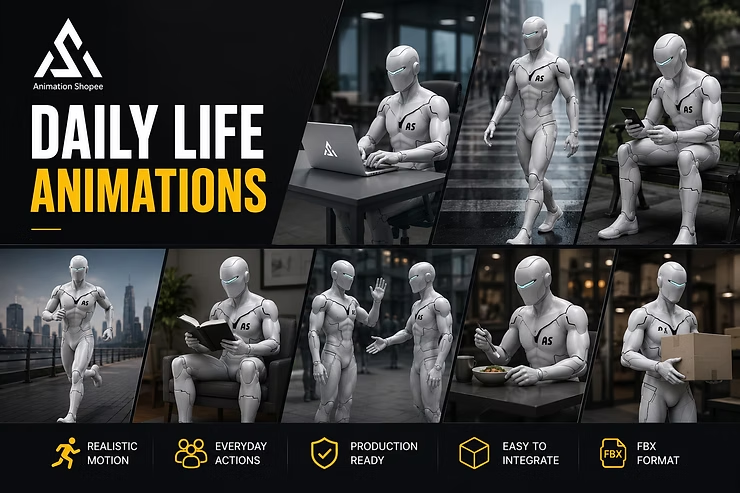
Daily Life Animations provide these familiar human actions for games, films, simulations, virtual production and digital-human experiences. They help creators develop characters that can function naturally between major gameplay or story events.
AnimationShopee includes Daily Life as a main animation category, covering multiple types of everyday character movement. These motion assets can support developers and artists who need practical human actions for modern 3D production.

Why Daily Life Movement Matters
Players and viewers understand ordinary human movement instinctively. They quickly notice when a character sits without adjusting body weight, holds a phone incorrectly or remains completely still during a conversation.
A believable performance depends on connected movement. Before sitting, a person approaches the chair, adjusts position, bends the knees and transfers weight. While seated, the body continues making small posture changes. Standing requires another controlled shift of balance.
These details help an action feel intentional instead of mechanical. Daily Life Motion Capture Animations can preserve the timing and coordination present in real human performances.
Daily Life Animation Categories
Everyday movement includes more than basic walking and idle loops. AnimationShopee’s Daily Life category presents subcategories connected to common actions and emotional situations, including:
Idle
Computer
Motor vehicles
Home
Crying
Running
Jumping
Walking
Phone usage
Sitting
Drinking
Fear-related actions
Crime-related actions
Unusual or specialized behavior
These movements can be used individually or combined into longer character sequences. The appropriate animation depends on the environment, character role and purpose of the scene.
Creating Believable NPC Behavior
NPCs should appear to have a purpose even when they are not directly interacting with the player. A character can walk to a location, check a phone, sit down, look around and return to an idle state.
A practical NPC behavior sequence may contain:
Idle
Start walking
Walk loop
Stop walking
Turn toward an object
Perform an interaction
Return to idle
Using only one idle or walk cycle across every NPC creates visible repetition. Different timings, starting positions, movement styles and actions can make a populated environment feel less artificial.
Animations should match the character’s context. An office worker, frightened civilian and relaxed person at home should not use identical posture, timing and gestures.
Transitions Connect Individual Actions
High-quality animation clips can still look unnatural when the transitions between them are poorly designed. The end pose of one action should connect logically with the beginning pose of the next.
For example, a standing character should not immediately switch to the middle of a sitting animation. The sequence should include an approach, alignment with the seat, weight transfer and final seated pose.
Developers should examine:
Starting and ending poses
Character position
Facing direction
Root movement
Hand placement
Contact with objects
Blend duration
Short blends can cause visible snapping. Excessively long blends may soften important movement and create sliding. Each transition should be tested inside the final character controller or scene.
Environment and Object Interaction
Many 3D Daily Life Animations involve contact with objects. Phone actions, computer use, drinking, sitting and vehicle interactions require accurate positioning between the character and the environment.
A chair must align with the character’s hips before the sitting animation begins. A phone must remain positioned relative to the hand. A cup must reach the mouth at the correct moment.
These actions often require attachment points, sockets, constraints or inverse kinematics. The animation supplies the body movement, while the scene setup controls the relationship between the character and the object.
Characters with different proportions may require adjustments. Arm length, hand size, torso height and overall scale can change the final contact position after retargeting.

Idle Animations Need Controlled Variation
An idle animation should not make a character appear frozen. Small breathing motion, weight shifts and subtle posture changes can preserve a sense of life without distracting from the scene.
Strong movement is not always better. Large gestures repeated frequently become noticeable and may not fit neutral gameplay situations.
A useful idle system can combine:
Neutral breathing
Small weight shifts
Short look changes
Relaxed posture adjustments
Context-specific gestures
Transitions into other actions
Variation should be controlled so that it supports the environment and character instead of producing random behavior.
Using Daily Life Animations in Unreal Engine
In Unreal Engine, imported FBX Animations can be assigned or retargeted to a compatible character skeleton. Daily-life actions may be managed through Animation Blueprints, State Machines, Montages or scripted sequences.
Locomotion and idle states normally remain inside a State Machine. Phone use, drinking, sitting or emotional reactions may be triggered through Montages or dedicated interaction states.
Animation Notifies can communicate important moments to gameplay logic. A notify could indicate when a character touches a chair, attaches an object to the hand or finishes an interaction.
Root motion should be evaluated for each action. A controlled cinematic interaction may benefit from animation-driven movement, while navigation-based NPCs may require movement controlled by the game system.
Using Daily Life Animations in Unity
Unity developers can configure imported FBX files through the Rig and Animation settings. Humanoid clips may be retargeted through an Avatar when the source and target bone mappings are compatible.
An Animator Controller can manage idle, walking and running states. Interaction actions can be activated through parameters or separate animation layers when the character must perform an upper-body movement while maintaining another state.
Developers should confirm loop settings for idle and locomotion clips. One-time actions such as sitting, drinking or phone interactions require clear entry and exit conditions.
Root-transform settings, transition duration and character movement speed should be tested together to prevent foot sliding and sudden position changes.
Editing and Retargeting in Blender or Maya
Blender and Maya can be used to inspect, retarget and modify Character Animations before final integration.
The source and target skeletons should begin from compatible reference poses. Differences between T-pose, A-pose and custom rest poses can affect the shoulders, arms, hips and legs.
After retargeting, inspect:
Foot contact
Hand and object alignment
Hip height
Knee direction
Shoulder rotation
Root position
Floor penetration
Daily-life interactions often need more correction than isolated actions because the character must align with furniture, devices or props.
Daily Life Animations for Films and Virtual Production
Daily-life actions are useful for more than gameplay. Films and virtual-production scenes need background characters, crowd activity and supporting performances. A station, office, house or public environment may require characters to walk, wait, sit, talk and interact with objects. These actions establish activity without distracting from the main performance. Animation clips can be sequenced and adjusted to create longer background behavior. Timing offsets can prevent several characters from performing the same action simultaneously.
Daily Life Motion for AI and Robotics
Human-motion data can support research into behavior modeling, motion analysis, imitation learning and digital-human simulation. Everyday actions are especially useful because they represent common interactions between people, objects and environments.
However, character animation data cannot normally control a physical humanoid robot directly. Human and robot bodies have different joint limits, balance requirements, mass distribution and mechanical constraints.
Motion must be mapped to the target robot, adjusted for its physical limitations and validated within simulation or a controlled testing process.
Building a Reusable Daily Life Animation Library
A reusable library should organize animations according to action, character state and interaction type. Clear naming makes it easier to locate related clips and construct complete sequences. For example, sitting animations can be grouped into approach, turn, sit, seated idle and stand variations. Phone animations may include taking out the phone, reading, typing, calling and putting it away.
Creators can browse AnimationShopee for Daily Life Animations and related character movements. Testing selected assets on the actual target rig remains important before building a complete system.
FAQ
What Are Daily Life Animations?
Daily Life Animations are 3D character movements based on familiar human behavior, including walking, sitting, phone use, computer activity, drinking, idle actions and emotional reactions. They are used to create believable characters in games, films, simulations and virtual environments.
Can Daily Life Animations Be Used for NPCs?
Yes. Daily-life actions can help NPCs walk between locations, wait, use objects, sit and react to their surroundings. Multiple animation variations and controlled timing should be used to prevent repetitive behavior.
How Are Daily Life Animations Used in Unreal Engine and Unity?
In Unreal Engine, developers can manage animations through Animation Blueprints, State Machines and Montages. In Unity, clips can be organized through an Animator Controller. Both engines may require skeleton mapping, retargeting and root-motion configuration.
Why Do Object Interactions Look Misaligned After Retargeting?
Misalignment can occur when the target character has different body proportions from the original performer or source skeleton. Hand placement, hip height and object position may require adjustment through constraints, sockets, inverse kinematics or additional keyframes.
Can Daily Life Motion Data Support AI or Humanoid Robotics?
Human-motion data can provide useful reference material for simulation, imitation learning and behavior research. It must be adapted to the target robot’s joint limits, balance system and mechanical structure before physical use.
Conclusion
AnimationShopee Daily Life Animations give digital characters the movement required between major actions. Walking, sitting, waiting, using objects and responding to the environment help characters behave like active participants in a scene.
Effective results depend on suitable animation selection, clean transitions, accurate object alignment and proper retargeting. A structured daily-life animation library can support believable NPCs, films, digital humans, simulations and interactive 3D experiences.


Comments